
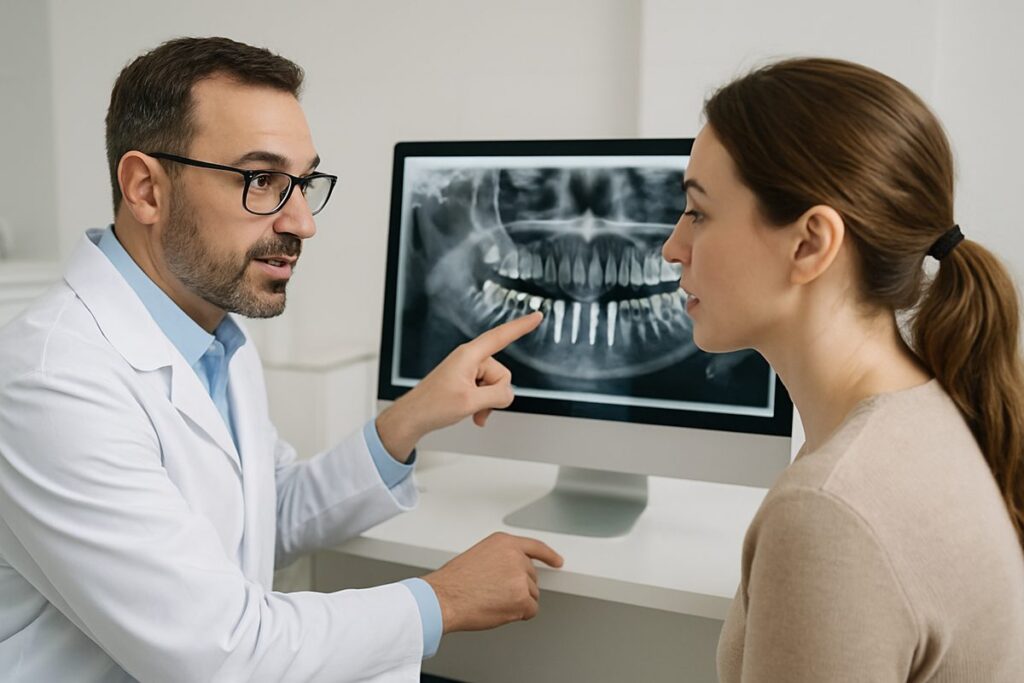
A dentist implant specialist is a clinician trained to replace missing teeth with dental implants and to restore function and appearance when standard care isn’t enough. Patients seek a dentist implant specialist for predictable, long-term tooth replacement, better chewing, and to stop shifting teeth or bone loss. This short guide explains when to see a specialist, common implant options, how treatments are planned, what surgery and recovery look like, factors that affect success and cost, key questions to ask, and how Advanced Implant Dentistry & Oral Restoration can help.
When Should You See a Dentist Implant Specialist?
Common reasons to see a specialist include one or more missing teeth, failing or broken teeth that aren’t worth saving, loose or uncomfortable dentures, and bite or jaw problems caused by tooth loss. General dentists often place simple implants but will refer to a specialist when cases are complex—such as severe bone loss, multiple missing teeth, need for grafting, or full-arch restorations.
Types of Implant Treatments Explained
Single-tooth implants
A single implant replaces one missing tooth with a titanium implant topped by an abutment and a crown. This restores chewing, stops neighboring teeth from shifting, and looks natural.
Multiple implants and implant-supported bridges
When adjacent teeth are missing, two or more implants can support a bridge. This is often recommended over separate single implants when space, cost, or bone health favors a shared restoration.
Full-arch solutions / Teeth-in-a-Day
All-on-4 and All-on-X use strategically placed implants to support a full arch of teeth. Immediate-load or “teeth-in-a-day” protocols allow placement of a temporary prosthesis the same day as surgery for quick functional and cosmetic results.
How a Dentist Implant Specialist Plans Your Treatment
Specialists use CBCT scans, digital impressions, and 3D planning software to assess bone, nerves, and sinus anatomy. Guided surgical guides are often 3D-printed to place implants precisely. This digital workflow improves safety, reduces surprises, and allows predictable, reproducible results.
What to Expect During Surgery and Recovery
Surgery typically involves local anesthesia with optional oral or IV sedation. The implant is placed into the jawbone, sometimes with bone grafting, and a healing cap or temporary prosthesis is attached. Patients feel pressure but usually not sharp pain during the procedure. Expect swelling and mild discomfort for a few days, pain controlled with prescribed or over-the-counter medication, and several months for integration before the final restoration is placed.
Factors That Affect Implant Success and Cost
Bone quality and need for grafting
If bone is thin or lost, grafting (including S.M.A.R.T.™ techniques) may be needed to build a stable foundation. Grafting adds time and cost but improves long-term success.
Medical history and oral hygiene
Diabetes, smoking, certain medications, and poor oral hygiene can affect healing and increase risk. Specialists factor these into planning and may recommend medical clearance or behavior changes.
The restoration type and materials
Choices like zirconia versus porcelain, and temporary versus final prostheses, affect aesthetics, durability, and price. Higher-end materials often offer better long-term value.
Questions to Ask a Dentist Implant Specialist
- Years of experience and specific certifications - How many implants and full-arch cases they’ve placed - Use of digital workflow (CBCT, guided surgery) - Before-and-after case photos - Protocols for complications and emergencies - Financing options and warranties
Why Consider Advanced Implant Dentistry & Oral Restoration
Advanced Implant Dentistry brings 30+ years of implant experience with combined surgical and prosthodontic expertise, an in-house lab, and same-day workflows. The practice offers minimally invasive S.M.A.R.T.™ grafting, guided surgery, and teeth-in-a-day options for faster, more predictable care.
Meet the doctors (brief)
Dr. Michael Klein — board-certified prosthodontist and implant pioneer. Dr. Allon Waltuch — fellowship-trained implant surgeon with an aesthetic focus.
Key technologies that improve outcomes
- CBCT (RayScan) - 3Shape TRIOS scanner and Implant Studio software - Guided implant planning and 3D-printed surgical guides - In-house milling and 3D printing, PRGF, and S.M.A.R.T. grafting
Closing: How to Take the Next Step
Schedule a consultation or request a digital treatment plan to review your options and expected outcomes. A visit with a dentist implant specialist clarifies the best path to restore your smile, function, and confidence.